

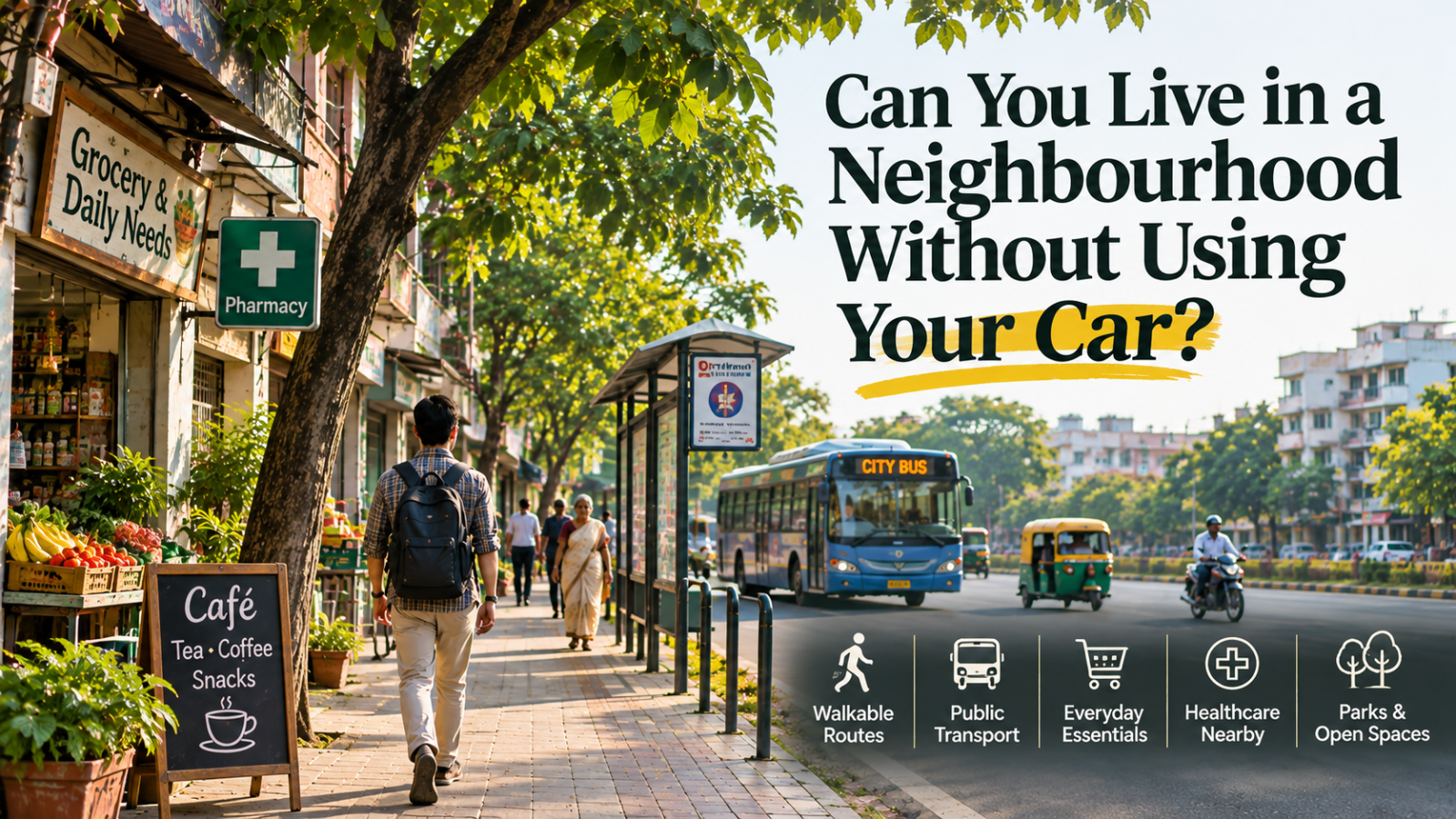
Imagine stepping outside your home to buy groceries, picking up a prescription from a nearby pharmacy and reaching your favourite café without starting your car. For some people, this is an ordinary part of daily life. For others, even a short trip requires getting behind the wheel. The difference often comes down to the neighbourhood they live in. Before buying a property, ask yourself a simple question: can you manage your everyday routine without depending on a car? The answer might tell you more about a property's location than its brochure ever will.
1. Start With Your Everyday Essentials
A neighbourhood does not need shopping malls and entertainment centres on every corner to be convenient. What matters is whether you can access the places you regularly visit without travelling long distances. Start by identifying the essentials:- Grocery stores and vegetable markets
- Pharmacies and healthcare facilities
- Schools and childcare centres
- Banks and ATMs
- Parks and recreational spaces
- Public transport stops
2. Look Beyond the Distance on Google Maps
A location pin can tell you how far away a destination is, but it cannot always tell you how pleasant or safe the journey will be. Walk the route yourself. Check whether the footpaths are continuous, pedestrian crossings are available and street lighting is adequate. Observe how vehicles move through the area and whether pedestrians have enough space. Pay attention to:- Broken or obstructed footpaths
- Roads without designated pedestrian crossings
- Poor street lighting
- Heavy traffic near residential entrances
- Encroachment on pedestrian spaces
3. Test the Neighbourhood at Different Times
A neighbourhood can feel peaceful in the morning and become congested during the evening rush. Visit the area at different times of the day. Walk to a grocery store in the morning, check public transport availability during peak hours and explore the surrounding streets after sunset. Also consider how the neighbourhood behaves during the monsoon and summer. Poor drainage, waterlogging, extreme heat and a lack of shaded walking routes can make short distances surprisingly difficult to cover. The objective is to understand how the area functions throughout an ordinary day, not just during a convenient property visit.4. Check Public Transport and Last-Mile Connectivity
Living without a car does not necessarily mean walking everywhere. A well-connected neighbourhood should also offer convenient access to buses, metro stations, suburban rail or other public transport options. Check how far the nearest transport stop is, how frequently services operate and whether you can safely reach the stop on foot. This is particularly important if your workplace, college or other regular destinations are outside the immediate neighbourhood. A nearby bus stop is useful only if the service is reliable and the journey is practical.5. Understand the 15-Minute Neighbourhood Concept
Urban planners often use the idea of a 15-minute city to describe neighbourhoods where residents can reach many everyday necessities within approximately 15 minutes by walking or cycling. The concept prioritises accessibility to essential services, education, healthcare, recreation and local commerce. However, the idea should not be treated as a universal property-buying formula. Indian cities have different infrastructure, climates, employment patterns and transport challenges. A neighbourhood may offer excellent local convenience while still requiring a longer commute to work. The real objective is to reduce unnecessary dependence on private vehicles, not eliminate every journey that requires one.6. Your Car-Free Neighbourhood Test
Before finalising a property, try this simple exercise. Spend a day in the neighbourhood without using your car. Walk to the nearest grocery store, pharmacy and public transport stop. Find a place to eat, visit a nearby park and observe how comfortable the journeys feel. Ask yourself:- Could I complete these errands without a vehicle?
- Are the walking routes safe and convenient?
- Can I access public transport easily?
- Would this location work for my everyday routine?


No comments
Log in or create a free account to join the conversation.