

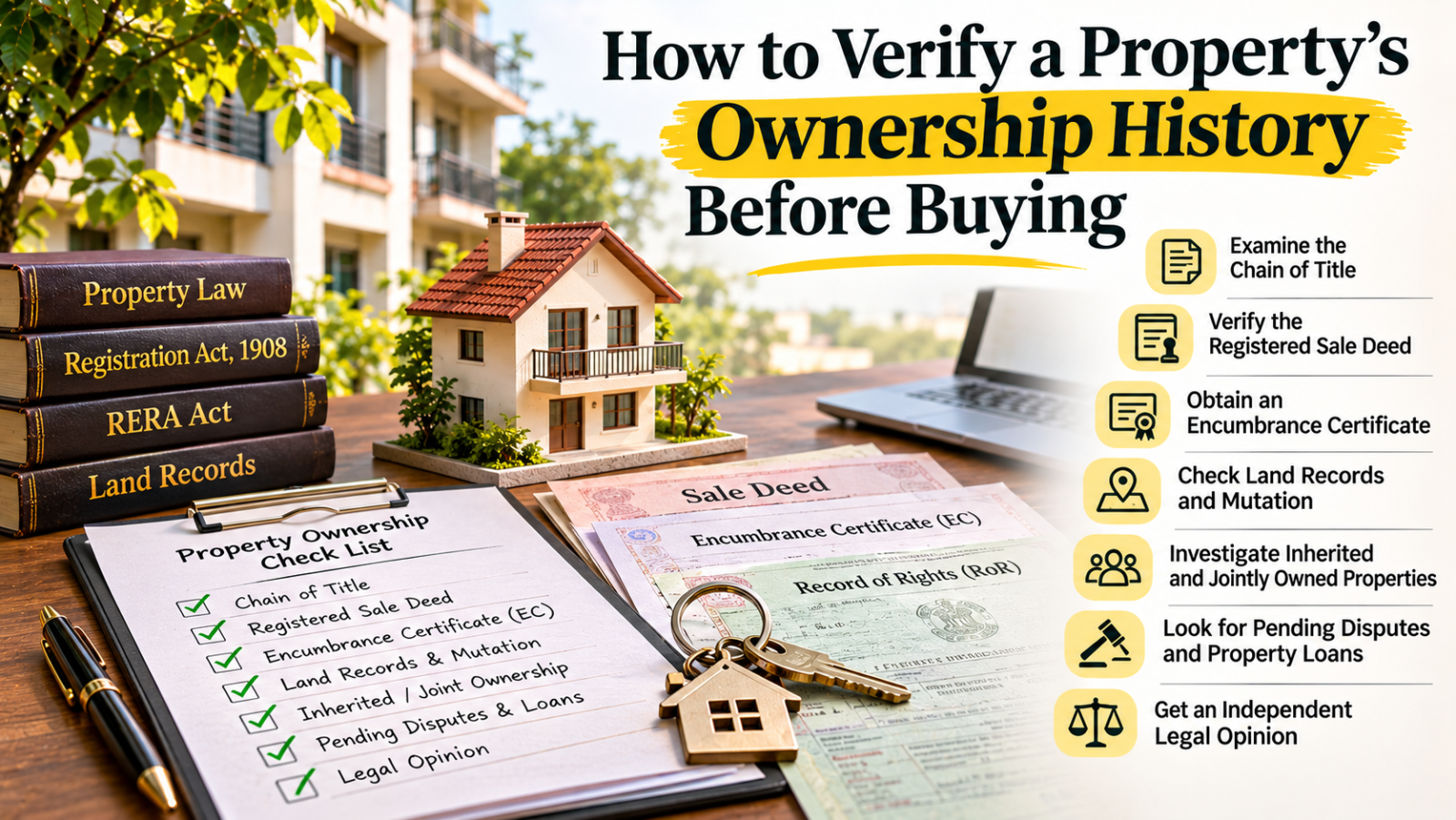
1. Start With the Chain of Title
The first step is to examine the chain of title, which refers to the sequence of ownership transfers through which a property has passed from one owner to another.
For example, a property may have originally belonged to one individual before being transferred through a sale, inheritance or gift. Each subsequent transfer should be supported by relevant legal documents.
Ask the seller for copies of:- Original or previous sale deeds.
- Gift deeds, if ownership was transferred as a gift.
- Partition deeds, where the property was divided among family members.
- Succession or inheritance documents, where applicable.
- Court orders or settlement documents, if ownership resulted from litigation.
Ask an independent property lawyer to examine the chain of title, generally covering the previous 30 years or another appropriate period based on the property's circumstances and applicable legal requirements.
The objective is to establish whether each transfer was legally valid and whether the present seller acquired a transferable ownership interest.
2. Verify the Registered Sale Deed
A sale deed is one of the most important documents in a property transaction. It records the transfer of ownership from the seller to the buyer and contains details such as the parties involved, property description, consideration and registration information.
Do not rely entirely on a photocopy supplied by the seller.Check the registration details, including the document number, registration date, Sub-Registrar Office and names of the parties. Where possible, obtain a certified copy from the relevant registration office and compare it with the document provided.
You should also verify whether the property description, survey number, plot number, boundaries and area match the actual property being offered for sale.
The Registration Act, 1908 provides for the registration and inspection of relevant property documents. However, registration alone does not guarantee that the seller has a valid title. The buyer must independently examine the ownership history.
3. Obtain an Encumbrance Certificate
An Encumbrance Certificate (EC) helps identify registered transactions and certain financial or legal interests recorded against a property during a specified period.
It can reveal registered mortgages, previous sales and other registered encumbrances, depending on the records maintained by the relevant registration authority.
Before purchasing, request an EC covering the relevant ownership period and examine it carefully.
Pay particular attention to:- Existing registered mortgages.
- Previous sale transactions.
- Registered agreements or claims affecting the property.
- Any discrepancies between the EC and the seller's documents.
However, an EC should not be treated as a complete guarantee that a property is free from every liability. Unregistered claims, pending litigation and certain statutory dues may not appear in it.
Ask your property lawyer to conduct additional searches and, where necessary, obtain information from the relevant lender or authority.
4. Check Land Records and Mutation Details
Revenue records can provide useful information about the recorded landholder, property classification, area and land-related transactions.
Depending on the state, these records may be called Record of Rights (RoR), Jamabandi, Khata, Khatian or Patta.
Check whether the seller's name, land particulars and property boundaries correspond with the documents presented.
It is equally important to understand mutation. Mutation is the process of updating revenue records after a change in ownership, such as a sale or inheritance.
However, remember that mutation does not independently establish ownership. The Supreme Court has repeatedly clarified that mutation entries serve a revenue-related purpose and do not create or extinguish title to property.
Therefore, do not purchase a property simply because the seller's name appears in the latest land records.
5. Investigate Inherited and Jointly Owned Properties
Inherited properties require additional attention because the person selling the property may not be its only legal heir or claimant.
For example, a house inherited by several family members may still have unresolved ownership rights even if only one person is negotiating the sale.
Ask whether the property was inherited, partitioned or transferred through a will.
Depending on the circumstances, relevant documents may include:- Death certificate of the previous owner.
- Will and applicable probate or court documents, where required.
- Legal heir or succession documents.
- Registered partition or release deed.
- Written consent or legally valid participation of all necessary co-owners.
Do not assume that one family member can automatically sell an entire inherited property. Have a lawyer establish who holds the legal interest and whose participation or consent is required.
6. Check for Pending Disputes and Property Loans
Even when the ownership documents appear consistent, the property could be involved in a court dispute, loan arrangement or other legal restriction.
Ask the seller for a written disclosure of existing loans, litigation, acquisition notices and other claims affecting the property.
Check relevant court records where necessary and verify whether any lender has a registered security interest over the property.
If the property was previously mortgaged, obtain appropriate evidence that the loan has been repaid and the mortgage or charge has been released. Where applicable, verify the relevant registration and CERSAI records as part of the legal search.
If the property is part of a registered real estate project, also check the project's details and disclosures on the relevant state RERA portal.
7. Get an Independent Legal Opinion Before Paying
Collecting documents is only the beginning. Their legal meaning, authenticity and consistency need to be examined together.
Before making a substantial payment, appoint an independent property lawyer to review the title documents, registration records, encumbrances, land records and relevant court proceedings.
Avoid relying exclusively on a lawyer recommended by the seller or builder.
If the ownership history contains unexplained gaps, conflicting documents or unresolved claims, do not proceed until the issues are properly addressed.
Frequently Asked Questions
1. How many years of property ownership history should I check?
A 30-year title search is commonly used as a due diligence benchmark, but the appropriate period depends on the property's history and legal circumstances. Ask a property lawyer to determine the required search period.2. Does an Encumbrance Certificate prove clear ownership?
No. It helps identify registered transactions and certain recorded encumbrances, but it does not establish complete ownership or reveal every possible legal claim.3. Is mutation enough to prove property ownership?
No. Mutation updates revenue records for administrative and tax purposes. It does not independently create legal title.4. Can I buy an inherited property from one family member?
Only if that person has the legal right to transfer the interest being sold. Where multiple heirs or co-owners have rights, their participation or legally valid consent may be necessary.Verify the History Before Buying the Future
A property purchase involves more than choosing the right location and negotiating the price. Its ownership history must also withstand legal scrutiny. Examine the chain of title, verify registered documents, investigate possible claims and obtain independent legal advice before committing your money.
At Real Estate, explore reviewed property listings, verified agent profiles and neighbourhood insights to make better-informed property decisions. Because a good property purchase should begin with confidence in what you are buying.


No comments
Log in or create a free account to join the conversation.