

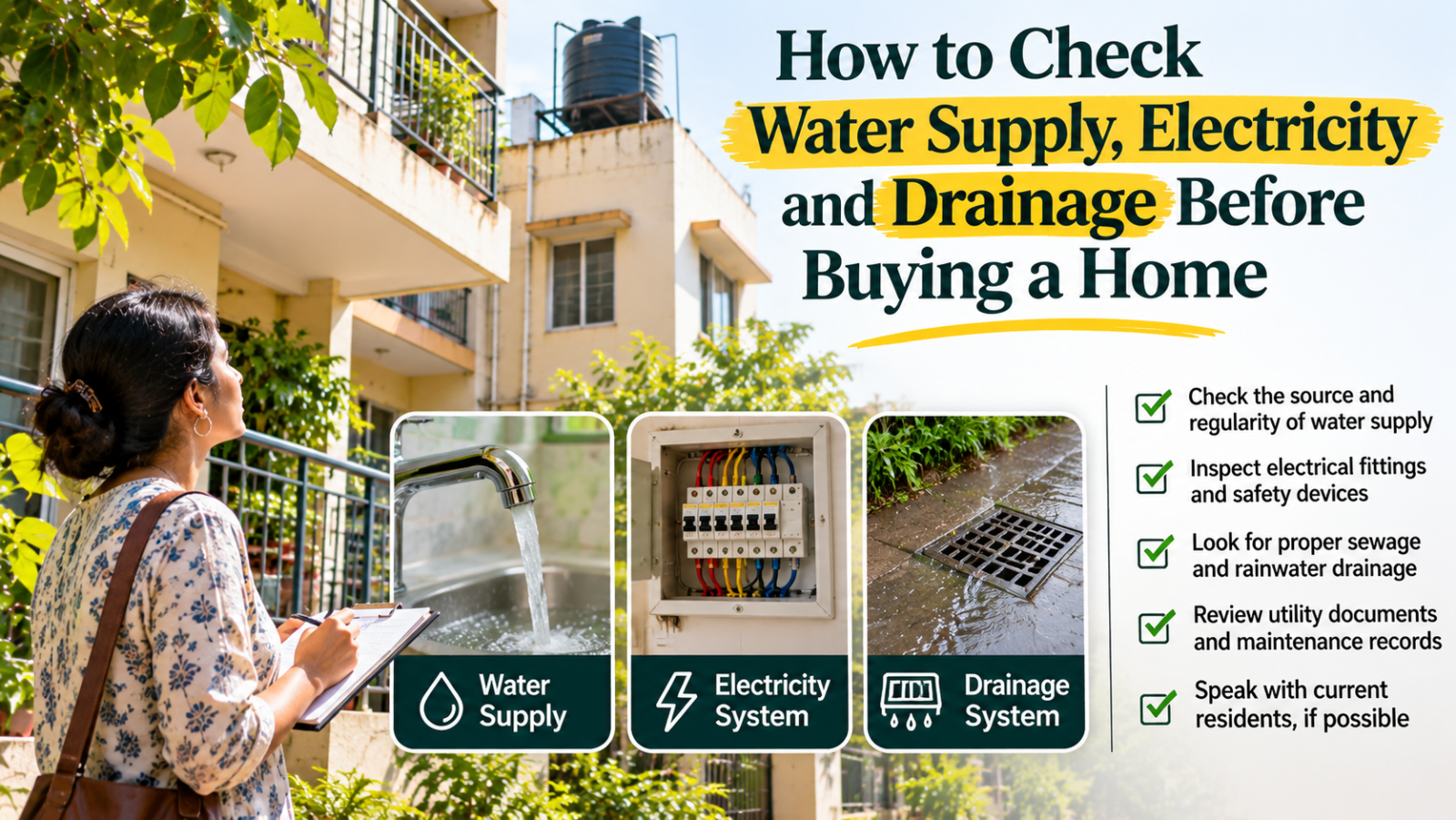
A newly painted apartment, spacious rooms and an attractive price can make a property difficult to resist. But have you checked whether water reaches the taps regularly, whether the electrical system can handle everyday usage or whether rainwater drains away properly? These are not details you should leave for after moving in. Problems with essential utilities can turn an otherwise attractive property into an expensive and frustrating place to live. Before signing a property agreement, take time to inspect three things: water supply, electricity and drainage.
1. Check the Water Supply Before Anything Else
A reliable water supply is one of the most important requirements of comfortable living. However, not every residential property receives water in the same way.
Some buildings depend on municipal connections, while others rely on borewells, water tankers or a combination of different sources.
Before purchasing, ask the seller or builder:- What is the primary source of water?
- Is the municipal water connection operational?
- Does the building depend on borewell water during shortages?
- How frequently does the overhead tank receive water?
- Are residents required to purchase water tankers during summer?
If possible, visit the property early in the morning and check whether water is available in the kitchen, bathrooms and utility areas.
Check Water Quality and Storage
Water availability does not automatically mean water quality is satisfactory.
Observe the colour, smell and appearance of the water, but remember that these observations cannot establish whether it is safe to drink.
Ask whether the building conducts periodic water quality testing. For a more reliable assessment, arrange laboratory testing against the relevant Bureau of Indian Standards specification, IS 10500, for drinking water.
Also inspect the overhead and underground water storage tanks. Ask when they were last cleaned and whether there is a regular maintenance schedule.
The Government of India's Jal Jeevan Mission uses BIS drinking water standards as a benchmark and recommends monitoring water quality at different points in the supply system.
2. Inspect the Electrical System and Power Supply
Electricity problems can affect everything from everyday appliances to personal safety.
During your property inspection, pay attention to the electrical fittings, distribution board, switches and visible wiring.
Look for:- Damaged or exposed electrical wires.
- Loose switches and sockets.
- Burn marks or unusual smells around electrical fittings.
- Properly labelled circuit breakers.
- Signs of overheating around the distribution board.
Ask whether the property has appropriate earthing and protective devices such as miniature circuit breakers (MCBs) and residual current circuit breakers (RCCBs or RCDs).
These devices serve different safety purposes. An MCB helps protect against overcurrent and short circuits, while an RCD helps protect against certain electrical leakage faults.
Do not attempt to open electrical panels or test wiring yourself. If you notice anything suspicious, arrange an inspection by a qualified electrician.
Understand the Power Backup Arrangement
Power cuts can be inconvenient, particularly in apartment buildings that depend on lifts, water pumps and other shared facilities.
Ask the building management:- Is there a generator or backup power system?
- Which areas receive backup electricity?
- Are lifts and water pumps connected to the backup supply?
- Are individual flats provided with inverter or generator support?
- Are there additional charges for backup electricity?
A building may advertise power backup without providing uninterrupted electricity to every apartment. Understand exactly what is covered before making a decision.
3. Examine the Drainage and Sewage System
Drainage problems are often overlooked during property visits because their effects become more visible during heavy rainfall.
Start by checking the bathrooms, kitchen, balconies and utility areas. Run the taps briefly and observe whether water flows into the drains without backing up.
Look for signs such as:- Water collecting around bathroom floor drains.
- Slow drainage from kitchen sinks.
- Unpleasant smells coming from drainage outlets.
- Damp patches around bathroom walls.
- Water accumulation near the building entrance.
- Signs of leakage around basement or parking areas.
If you are buying an independent house, check whether the property is connected to the municipal sewerage network or uses a septic tank.
For properties with septic tanks, ask about their maintenance, cleaning frequency and accessibility for desludging.
For apartments, understand how wastewater is collected and disposed of. Ask whether the building has a sewage treatment plant (STP), particularly if it is required under the applicable local approvals.
Don't Confuse Sewage Drainage With Rainwater Drainage
These are two different systems, and both deserve attention.Sewage drainage carries wastewater from kitchens, bathrooms and toilets. Stormwater drainage is designed to carry rainwater away from buildings and surrounding spaces.
Check whether rainwater outlets are clear, terrace drains are maintained and the property has an effective arrangement for directing rainwater away from its foundations.
Also observe the surrounding roads and nearby drainage channels. A building may have an adequate internal drainage system but still face access problems if the locality experiences recurring waterlogging.
The Central Public Health and Environmental Engineering Organisation (CPHEEO), under the Ministry of Housing and Urban Affairs, publishes separate technical manuals covering sewerage and stormwater drainage systems.4. Ask for Documents Instead of Depending on Verbal Assurances
A builder or seller might assure you that everything is in working condition. However, important details should be supported by records wherever applicable.
Before purchasing, request:- Evidence of the property's water connection and applicable utility bills.
- Electricity connection details and sanctioned load.
- Available electrical inspection or maintenance records.
- Details of sewage and stormwater connections.
- Occupancy or completion certificates, where applicable.
- Information about maintenance responsibilities and pending utility dues.
5. Make Essential Utilities Part of Your Property Inspection
Before finalising a property, visit it more than once and test what can safely be tested.Check water availability, inspect visible electrical fittings, observe drainage performance and ask residents about recurring problems.
Do not rely entirely on a model apartment, brochure or builder's promises. If the property is under construction, verify the approved utility arrangements and the expected completion of essential connections.
A little verification before purchase can prevent substantial repair costs and daily inconvenience later.Frequently Asked Questions
1. How do I check water supply before buying a flat?
Identify the water source, check availability at different times, inspect storage tanks and request recent water quality test reports where available.2. What electrical safety features should a house have?
Check appropriate earthing, circuit breakers, residual current protection and properly maintained wiring. Have a qualified electrician assess the installation.3. How do I identify drainage problems in an apartment?
Look for slow-draining sinks, water accumulation, unpleasant smells, damp patches and signs of leakage in bathrooms, balconies and common areas.4. What is the difference between a sewage system and a stormwater drainage system?
Sewage systems carry wastewater from toilets, kitchens and bathrooms, while stormwater systems manage rainwater from roofs, roads and open spaces.Check the Essentials Before Choosing Your Home
A good property is not defined by its interiors alone. Reliable water, safe electricity and effective drainage are fundamental to comfortable everyday living. Before making a purchase, inspect these systems, verify the available documentation and understand the maintenance responsibilities.
At Real Estate, explore reviewed property listings, verified agent profiles and neighbourhood insights to make better-informed property decisions. Because finding the right home means looking beyond its appearance and understanding how well it actually works.


No comments
Log in or create a free account to join the conversation.